
Teaching Hashrate Arithmetic to Someone Who Has Never Mined
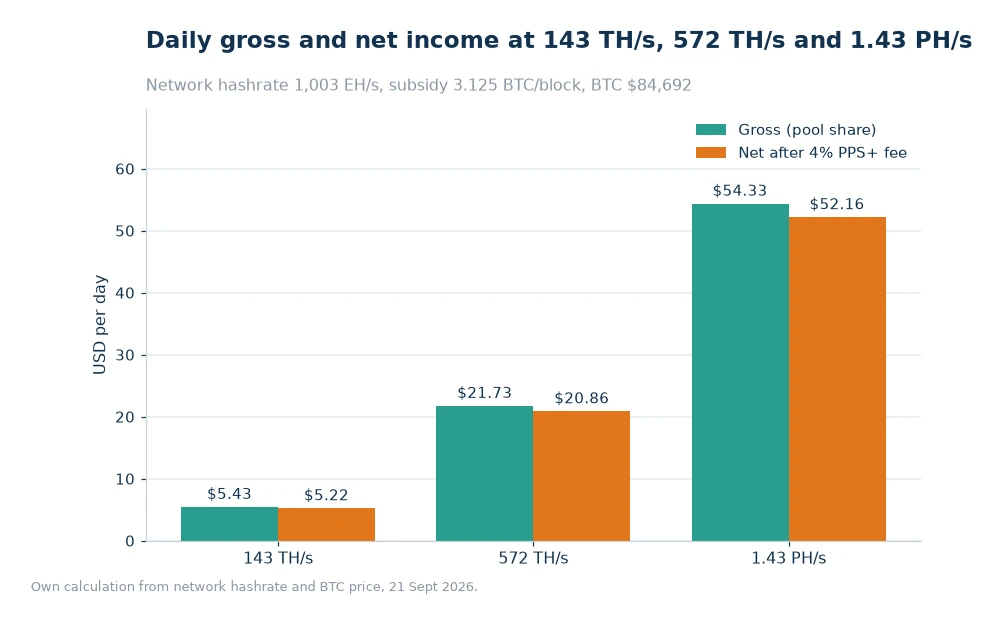
Most explanations of mining start with the coin and end with a chart. A better lesson starts with one block. The network issues 3.125 BTC every ten minutes, about 450 BTC a day across all miners, and your share of that is simply your share of the hashrate. At 143 TH/s that share is 0.00006415 BTC a day, $5.43 at $84,692 and $5.22 after the listed 4%.

Key takeaways
- One block pays 3.125 BTC, and 144 blocks a day means 450 BTC shared across the network.
- 143 TH/s earns 0.00006415 BTC a day, $5.43 gross and $5.22 net at the listed 4%.
- 572 TH/s and 1.43 PH/s are four times and ten times that size, and every figure scales with them.
- The method survives a price change; the answer does not, which is the lesson worth teaching.
Begin with the block, not the coin
Ask a beginner what a miner does and the answer usually involves solving puzzles for coins. That framing makes the numbers feel arbitrary. Replace it with a toll booth: every ten minutes the network hands out a fixed payment, and the payment is split in proportion to how much guessing power each participant contributed. No one is racing for a single prize; everyone is holding a ticket in a continuous raffle.
Once the raffle is the picture, the arithmetic follows. The size of the prize is fixed per block. The number of blocks per day is fixed at 144. The only variable that matters for a single miner is the fraction of total tickets held. Everything else, the price, the fee plan, the hardware, is a modifier on that fraction or on the value of the prize.
It also explains something beginners find counter-intuitive: a faster machine does not take coins from a slower one directly. It changes the fraction, and the fraction is recomputed against every other participant in the world. Mining is not a race between neighbours, which is why a new machine next door barely moves your own daily figure.
The fraction that explains the system
Write the fraction on a board: your hashrate divided by the network hashrate. At the read date the network was running at about 1,003 EH/s, which is 1,003,000,000 TH/s. A 143 TH/s machine therefore holds 143 ÷ 1,003,000,000 of the tickets, or about 0.000000143. Multiply that fraction by 450 BTC and the daily income appears.
This is the moment a beginner stops needing a calculator to understand the shape of the problem. Doubling the hashrate doubles the fraction. Doubling the network halves it. Nothing else in the system changes the fraction, which is why a price rise does not make a machine more productive and a difficulty rise does. Say the sentence out loud once with real numbers and it tends to stick.
Three sizes worked on the board
The table is deliberately repetitive: same formula, three scales. Repetition is what turns a formula into intuition. Cover the right-hand column and ask the class to fill it in; the pattern does the teaching.
| Hashrate | Working | BTC per day | Gross USD | Net USD |
|---|---|---|---|---|
| 143 TH/s | 143 ÷ 1,003,000,000 × 450 | 0.00006415 | $5.43 | $5.22 |
| 572 TH/s | four times the row above | 0.00025663 | $21.73 | $20.86 |
| 1.43 PH/s | ten times the first row | 0.00064151 | $54.33 | $52.16 |
Ask what the middle row would earn if the network doubled. The answer is half, immediately, without arithmetic. That single question tests whether the fraction has been understood or merely copied. It is also the question most published projections quietly avoid.
Where fees enter the lesson
Fees are the second fraction, and they are the place beginners get lost because the headline number is not applied to everything. Under the default PPS+ plan, the block reward carries a 4% charge while transaction fees carry 2% and is distributed on PPLNS logic. Under PPLNS, both portions are combined at a listed 2%.
Teach it as two buckets rather than one rate. The subsidy bucket is large and predictable; the fee bucket is small and variable. A 4% charge on the first and a 2% charge on the second is not a 6% charge on the total, and saying so once, clearly, prevents a dozen misunderstandings later. The fee schedule is the reference to hand over, and the ViaBTC Mining Guide explains how the two buckets are presented on the account page.
Why the answer moves next month
Two inputs in the fraction change constantly: the network hashrate and, through it, the difficulty. At the read date the next difficulty estimate was -2.12%, which would make each ticket slightly more valuable. A month later it could be the other way. The coin price changes too, and it changes the dollar column without touching the coin column.
This is the honest end of the lesson: the arithmetic is stable, the inputs are not. A projection is a photograph of a moving scene. Anyone who presents a single number as a forecast is either selling something or has not understood the fraction. The useful habit is to redo the two multiplications whenever an input changes, rather than to trust a figure printed last month.
An exercise that takes five minutes
Give the class three numbers and one question: a hashrate, the network total, and the subsidy. Ask for the daily coin output and the dollar value at a stated price. Then change one input and ask again. The repetition builds the habit of checking which variable moved before believing a number, and it gives the class a way to test any claim they meet later.
The ViaBTC Mining Calculator is a good second step because it exposes the inputs as fields. A learner who has done the arithmetic by hand can see immediately which field corresponds to which part of the fraction, and why a change in difficulty moves the answer in the opposite direction to a change in hashrate.
Worked example
Walk the whole calculation once, slowly, with the numbers on the board.
- Fraction of the network: 143 ÷ 1,003,000,000 = 0.0000001426.
- Daily coins: 0.0000001426 × 450 = 0.00006415 BTC.
- Gross dollars: 0.00006415 × 84,692 = $5.43.
- Net after the listed 4%: 5.43 × 0.96 = $5.21, which the table rounds to $5.22.
- Four times the hashrate: 4 × 0.00006415 = 0.00025660 BTC and 4 × 5.43 = $21.72, matching the $21.73 and $20.86 in the table after rounding.
- Ten times the hashrate: 10 × 0.00006415 = 0.00064150 BTC and 10 × 5.43 = $54.30, which is the $54.33 and $52.16 in the chart once the unrounded fraction is carried through.
- Per hour, for intuition: 5.22 ÷ 24 = $0.22, or about 0.00000267 BTC.
Frequently asked questions
What is a terahash in plain terms?
It is a trillion guesses per second. The network compares your guesses with everyone else's, so what matters is your share of the total rather than the absolute number on the box.
Why does a price rise not change the coin output?
Because the subsidy is paid in bitcoin and the fraction of it you receive depends on hashrate and difficulty. Price changes what those coins are worth in dollars, not how many arrive.
Is the 4% taken from the whole payout?
No. It applies to the PPS-settled block-reward component. The transaction-fee component follows PPLNS logic at a listed 2%, so the blended deduction is close to 4% only because the subsidy dominates block value.
Teach the method, not the number
End the lesson by changing the price by 20% and asking what happens to the dollar column. Then change the hashrate by 20% and ask again. The first moves every dollar figure in proportion; the second moves the coin figure too. A student who can say that sentence has learned more than a table of projections can teach, because the sentence still works when the numbers are different.
Keep the guide and fee page nearby for the account details, and let the arithmetic be done on paper. The method is the durable part.
Sources: ViaBTC pricing, calculator and guide pages[1]. Snapshot 21 Sept 2026: 1,003 EH/s, difficulty 132.76 T, 3.125 BTC subsidy, 144 blocks daily, BTC $84,692, next estimate -2.12%. Published 24 Oct 2026. Figures assume continuous uptime.